The surprising history behind ι, η, υ, ει, οι and υι.
If you’ve ever tried spelling a Greek word, you’ve probably wondered: Why are there so many ways to write the sound “ee”?
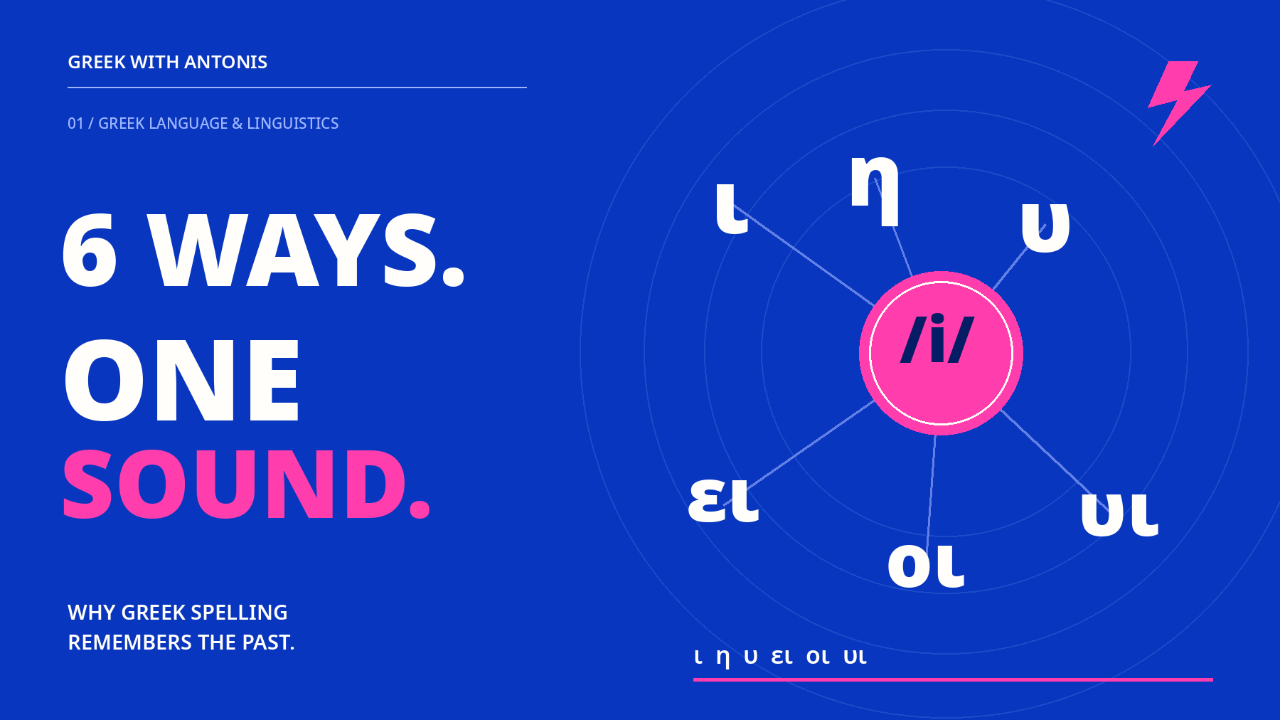
In Modern Greek, these six spellings are all pronounced /i/:
ι, η, υ, ει, οι, υι
For example:
ι — φίλος (friend) η — ημέρα (day) υ — ύπνος (sleep) ει — είμαι (I am) οι — οικογένεια (family) υι — υιός (son, formal)
Six different spellings. One sound. But why?
They Didn’t Always Sound the Same!
In Ancient Greek, these letters and combinations represented different sounds.
For instance, η was once a long, open e-like vowel, while υ was pronounced somewhat like the French u. The combination οι originally represented a diphthong, a sound that glided from one vowel to another.
Over the centuries, Greek pronunciation evolved. Sounds that had once been distinct gradually merged until they came to be pronounced /i/.
Linguists call this phenomenon iotacism (ιωτακισμός).
These changes didn’t happen simultaneously. They developed gradually, across different periods of Greek history.
So Why Keep All Six Spellings?
Because pronunciation changes much faster than spelling.
As people began pronouncing these sounds identically, traditional spellings continued to be used.
And those spellings still tell us something about the history and structure of Greek words.
Consider:
λείπει — he/she/it is missing λύπη — sadness
Both are pronounced lípi, but their different spellings help us distinguish them in writing.
The same historical process explains why Modern Greek also has ο and ω for /o/, or ε and αι for /e/.
Is Greek Spelling Actually Logical?
More than it might initially appear!
Greek spelling isn’t entirely phonetic, but it’s strongly connected to the language’s history, grammar, and etymology.
For learners, this means that memorizing spelling rules is useful, but understanding word families and origins can be even more powerful.
Greek spelling isn’t just about how words sound today. It’s also about how they sounded centuries ago.
So next time you’re struggling to choose between ι, η, υ, ει or οι, remember: you’re looking at thousands of years of linguistic history hiding inside an everyday word.

Antonis
Greek language tutor · Linguistics graduate
Antonis teaches Greek online and writes about language, etymology and Greek culture from Athens.
Reader comments.
Thoughts and conversations from our readers.
Leave a comment ↗
Share a thought or question. Comments appear publicly after review. Your email is kept privately for moderation, never displayed or used for marketing unless you opt in. You may request deletion by email.